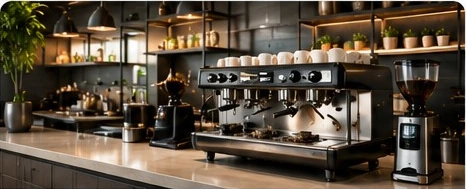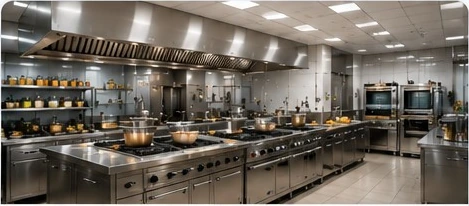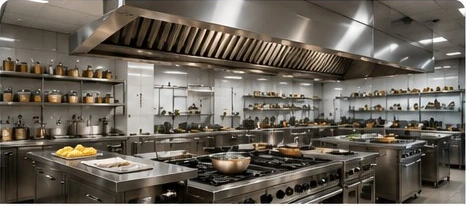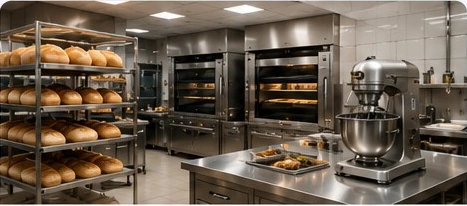
Hotel food operations often serve several outlets from one property: breakfast, à la carte dining, room service, conferences, banquets and staff meals. Equipment planning should therefore consider simultaneous demand, storage, transport and service across multiple departments.
1. Map every food-service outlet
List all points that prepare or serve food: main restaurant, breakfast area, coffee shop, bar, room service, conference rooms, pool service, banquet halls and staff dining. Identify which kitchen supplies each outlet and when demand overlaps.
A hotel may need to serve breakfast while preparing conference tea breaks and banquet mise en place. Plan shared equipment for the highest realistic overlap, not for one outlet in isolation.
2. Main production kitchen
The main kitchen usually needs a broader cooking and preparation range than a single restaurant. Typical requirements include commercial ranges, convection or combi-style ovens, fryers, grills, boiling pans or stock-pot stations, hot cupboards and heavy-duty extraction.
Hot kitchen
Ranges, ovens, grills, fryers, steam equipment and hot holding.
Cold kitchen
Preparation counters, slicers, processors and refrigerated workstations.
Butchery prep
Dedicated tables, sinks, cutting equipment and controlled cold storage.
Vegetable prep
Washing, peeling, cutting and mobile storage equipment.
3. Banquet and buffet equipment
Banquet service requires equipment for batch production, temporary holding, transport and presentation. Consider heated cabinets, banquet trolleys, chafing dishes, buffet counters, beverage urns, plate dispensers and mobile service stations.
Plan the route from kitchen to ballroom or conference area. Confirm lift size, corridor width, floor transitions and holding locations before selecting trolley dimensions.
4. Refrigeration, freezers and stores
Hotel operations need organized storage for fresh food, frozen stock, beverages, dairy, pastry ingredients and prepared items. Depending on scale, the property may use cold rooms, freezer rooms, upright cabinets, under-counter units and beverage refrigeration.
- Separate receiving and inspection area.
- Dry stores with commercial shelving.
- Chilled and frozen storage sized for delivery frequency.
- Secure beverage and high-value stores.
- Labelled internal transfer and holding containers.
- Temperature-monitoring and maintenance procedures.
5. Bakery and pastry section
Hotels producing bread, desserts and event pastries may require planetary or spiral mixers, dough sheeters, proofing equipment, bakery ovens, refrigerated pastry counters, racks, trays and ingredient storage.
Separate temperature-sensitive pastry work from the main hot kitchen where possible. Allow space for cooling, decoration, temporary storage and banquet preparation.
6. Stewarding and warewashing
Stewarding must handle plates, glassware, cutlery, kitchen utensils, pots and banquet equipment. A well-planned area normally separates incoming dirty items, pre-rinsing, washing, drying, clean storage and waste removal.
7. Internal transport and service support
Hotels rely heavily on mobile equipment. Include service trolleys, clearing trolleys, tray carts, insulated food carriers, housekeeping-compatible service routes and secure storage for mobile items.
Standardize pan and tray sizes where possible so equipment, shelving, ovens, holding units and trolleys work together.
8. Hotel opening checklist
- Every outlet and service period is included in the capacity plan.
- Shared equipment can handle realistic overlapping demand.
- Food, clean items, dirty items and waste have defined movement routes.
- Banquet trolleys fit doors, corridors and lifts.
- Cold storage reflects delivery frequency and event stock requirements.
- Stewarding capacity matches the largest event turnover.
- Smallwares, buffetware and replacement stock are fully quantified.
- Engineering teams confirm power, water, drainage, gas and extraction.